
Mont Blanc Ascent
Mont Blanc Ascent
Mont Blanc Ascent, 6 days:
Climbing Mont Blanc (4,808 m), the highest summit in the Alps, is a genuine mountaineering ascent: you need excellent fitness, proper acclimatisation to altitude, and the ability to walk in crampons on snow, ice and rock. Our 6-day programme is built to bring all three together before you head for the summit.
On the first two days, you climb Gran Paradiso (4,061 m) in Italy, to acclimatise and test yourself on a first 4,000 m peak. Day 3 is for rest, or an optional day climb. Then comes the 3-day ascent of Mont Blanc by the Goûter route, with a night at the Tête Rousse hut and one at the Goûter hut. You are led by an IFMGA mountain guide, with no more than two climbers per guide.
Mont Blanc Ascent
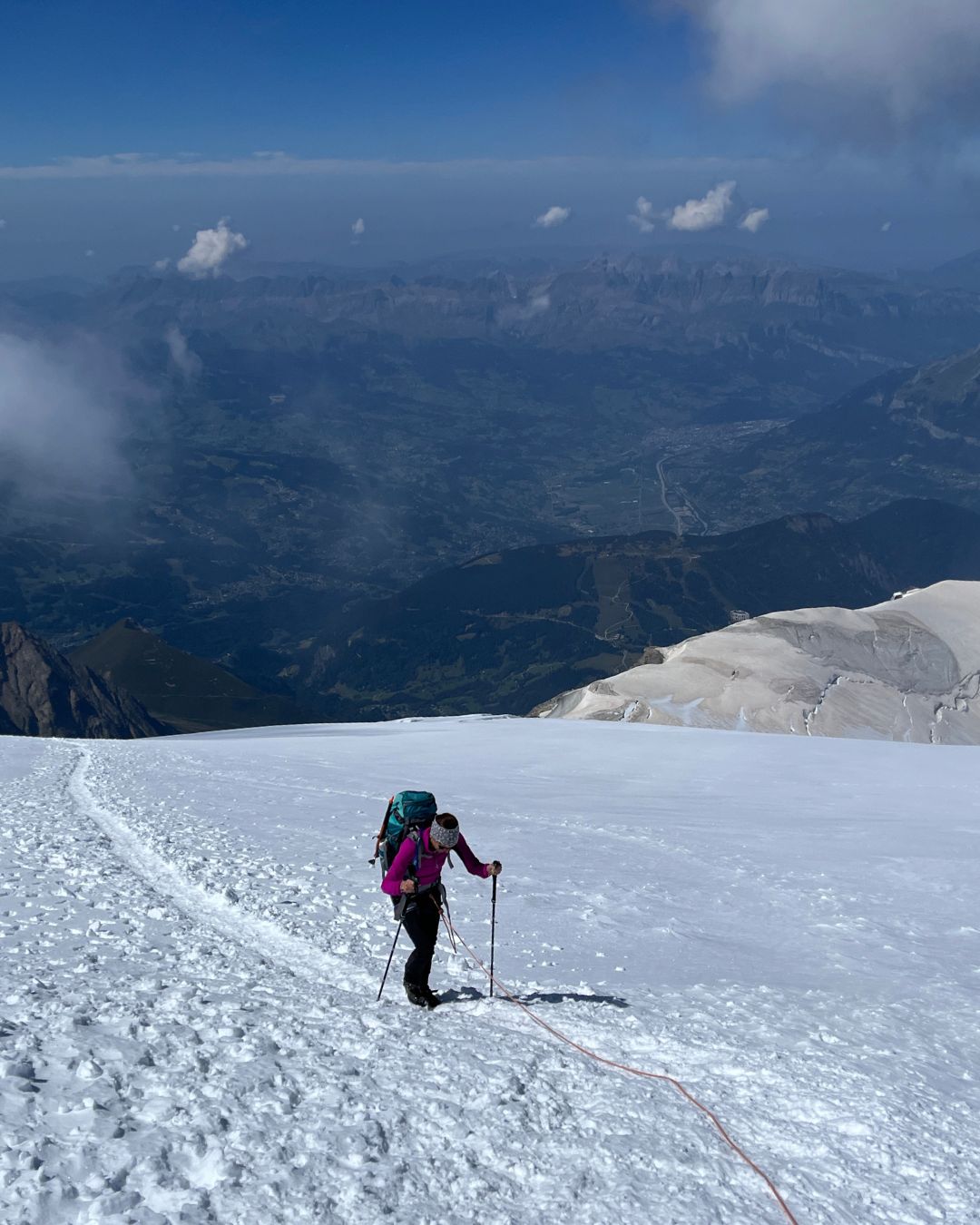
Why a 6-day programme to climb Mont Blanc?
Most failed attempts on Mont Blanc come down to two things: poor acclimatisation and insufficient fitness. The programme addresses them in three ways:
- Acclimatisation. Two days above 2,700 m and a 4,061 m summit prepare your body for the altitude of Mont Blanc.
- Technique. Gran Paradiso is the place to learn or refresh crampon technique and roped glacier travel, on technically easy terrain.
- Flexibility. Climbing Mont Blanc over three days spreads the effort and leaves room to adapt if the weather changes.
Be aware: three days do not make the ascent easy. Summit day, from Tête Rousse to the top and back to the Goûter, takes 8 to 12 hours of walking, with 1,700 m of ascent and 1,000 m of descent. All our clients say the same: Mont Blanc is a huge effort, and you need to be very well prepared to have a real chance of success — and above all, to enjoy it.
🗺️ Summits: Gran Paradiso (4,061 m) and Mont Blanc (4,808 m).
🏠 6 days, including 4 days in the high mountains.
⛏️ Mont Blanc route: Goûter Normal Route, over 3 days.
Booking – 6-Day Mont Blanc Course:
Searching Availability...
Mont Blanc Course Itinerary, Day by Day:
Departure from Chamonix to Italy and Pont, in the Valsavarenche, then up to the Federico Chabod hut. The next day, you climb Gran Paradiso, a technically easy 4,000 m peak that helps you acclimatise and gives you a clear idea of the effort Mont Blanc will demand. Back to Chamonix in the evening.
Day 1: 2 to 3 hrs to the hut · Day 2: 6 to 8 hrs for the summit and descent · night of day 1 at the Chabod hut, half board
A rest day is often welcome after two days in the high mountains. You can also add a day climb with your guide, such as the Cosmiques ridge — a mixed route from the Aiguille du Midi — or the Vallée Blanche traverse to Pointe Helbronner.
Night in Chamonix, not included · day climb available as an option
Departure in the early afternoon from the Bellevue cable car in Les Houches, then the Mont Blanc Tramway to the Nid d’Aigle (2,372 m). About two hours on a good path lead to the Tête Rousse hut.
Around 2 hrs · 📈 +800 m · night at the Tête Rousse hut, half board
An early start to cross the Grand Couloir and reach the Goûter hut (3,835 m). After a short break, leaving anything you don’t need for the summit, you set off for the final 1,000 m via the Dôme du Goûter and the Bosses ridge to the summit of Mont Blanc (4,808 m). Descent by the same route to the Goûter hut.
8 to 12 hrs · 📈 +1,700 m / 📉 −1,000 m · night at the Goûter hut, half board
An early start to make the most of good snow conditions on the way down, then back to the Nid d’Aigle and down by tramway and cable car. Arrival in Les Houches late morning or early afternoon.
3 to 5 hrs · −📉 1,460 m to the Nid d’Aigle
Guiding and Group Size
Your IFMGA mountain guide will lead a maximum of two participants throughout the trip. We prefer to form rope teams with people who already know each other: the success of the ascent depends on each person’s fitness, and pairing people who have never met can often lead to frustration.
Your guide may modify or adapt the programme and itinerary at any time, depending on the weather and mountain conditions. If our dates don’t suit you, get in touch: we’ll check availability at the Goûter hut for your preferred dates.
Fitness Level & Physical Condition
This course is suitable for you if:
You can comfortably complete hikes with 1,200 to 1,500 m of elevation gain in a day.
You can walk for 10 to 12 hours in a day, both uphill and downhill.
You already have some high-altitude mountain hiking experience, ideally using crampons.
You are prepared to train regularly in the months leading up to the trip.
Not sure if your fitness level is sufficient? Get in touch with us before booking.
Included
- An IFMGA mountain guide for the Gran Paradiso and Mont Blanc ascents, one guide for two climbers throughout
- Hut nights on half board (days 1, 4 and 5) for you and your guide
- Lift passes on days 4 and 6 (Bellevue cable car, Mont Blanc Tramway)
- Transport Chamonix – Pont – Chamonix (days 1 and 2)
- Shared safety equipment and harness loan
Optional extras on request
- A day climb with your guide on day 3
- Accommodation in Chamonix
- Transfers to and from Chamonix, including from Geneva airport [TBC]
Non included
- Accommodation in Chamonix on days 0, 2, 3 and 6
- Drinks at the Goûter hut, except trail tea (1 litre) and water with dinner (1.5 litres)
- Packed lunches, snacks and food for the climbs
- Personal equipment (clothing, mountaineering boots, crampons, rucksack…)
- Personal insurance: cancellation, assistance and repatriation
- Travel to Chamonix
- Personal expenses
- Anything not listed under “Included”
Ski de randonnée — Hospice du Grand-Saint-Bernard
⛏️How many days does it take to climb Mont Blanc?
The ascent by the Goûter route takes 2 or 3 days. Our programme lasts 6 days in total: 2 days of acclimatisation on Gran Paradiso, a rest day, then 3 days for Mont Blanc.
⛰️ How hard is it to climb Mont Blanc?
Above all, it demands excellent fitness: summit day takes 8 to 12 hours of walking, with 1,700 m of ascent and 1,000 m of descent. Technically, you need to walk in crampons on snow and mixed terrain; Gran Paradiso is where you learn or refresh this.
🇮🇹 Why climb Gran Paradiso before Mont Blanc?
To acclimatise to altitude, test yourself on a technically easy 4,000 m peak, and refresh your crampon technique before the Mont Blanc ascent.
👥 How many climbers per guide?
Two at most, throughout the programme. We prefer rope teams of people who know each other.
🗓️ When is the best time to climb Mont Blanc?
From June to September. For dates from late May to early June, conditions and logistics require a higher level, as the Bellevue cable car and the Mont Blanc Tramway are not yet running.
🌧️ What happens if the weather is bad?
Your guide adapts the programme: the 3-day ascent leaves some margin, and the order of the days can change with conditions.
🛏️ Where do you stay?
In mountain huts on half board on days 1, 4 and 5 (Chabod, Tête Rousse and Goûter huts). Nights in Chamonix are not included: we can suggest a hotel or an apartment.
🎒 What equipment do I need?
Provided:
- Group safety equipment: rope, carabiners and ice screws
- A climbing harness for each participant
What to Bring:
- Stiff mountaineering boots compatible with crampons
- Crampons and ice axe
- Helmet
- Warm layers, waterproof jacket and trousers, down jacket
- Warm gloves, overmitts and a hat
- Glacier sunglasses (category 4), sunscreen
- Headtorch
- 30–40 litre backpack
- Snacks and energy food for the ascents
All equipment can be rented in Chamonix — we can help you find the right rental shop.
🏠 Where can I stay in Chamonix?
In a hotel, with or without half board, or in a rented studio or apartment for your stay, handy for cooking and early breakfasts. Let us know your preference and we will make a suggestion.
🏔️ Can you climb Mont Blanc in a single day?
Yes, as a single push from Les Houches — but only for very fit, already acclimatised mountaineers. For a first ascent, the 6-day programme is far better suited.
Also discover..