
Mont Blanc single push
Mont Blanc single push: the one-day ascent
Climbing Mont Blanc (4,808 m), the highest summit in the Alps, from the valley and back without sleeping in a hut: that is the single push ascent. More than 3,800 m of ascent, the same in descent, 18 to 24 hours of continuous effort — first by night, then in full daylight — on high-altitude glacier and rock.
This is not the standard Mont Blanc climb. It is for mountaineers who know themselves well, already have altitude in their legs, and have the endurance to keep going when fatigue sets in. You climb with an IFMGA mountain guide, with one or two people at most on the rope.
Why choose the single push?
- Go when the weather is right. With no hut to book, departure is set by the best weather window, confirmed five days ahead.
- One continuous effort. You prepare for it like an endurance race, and climb it like a mountaineering ascent.
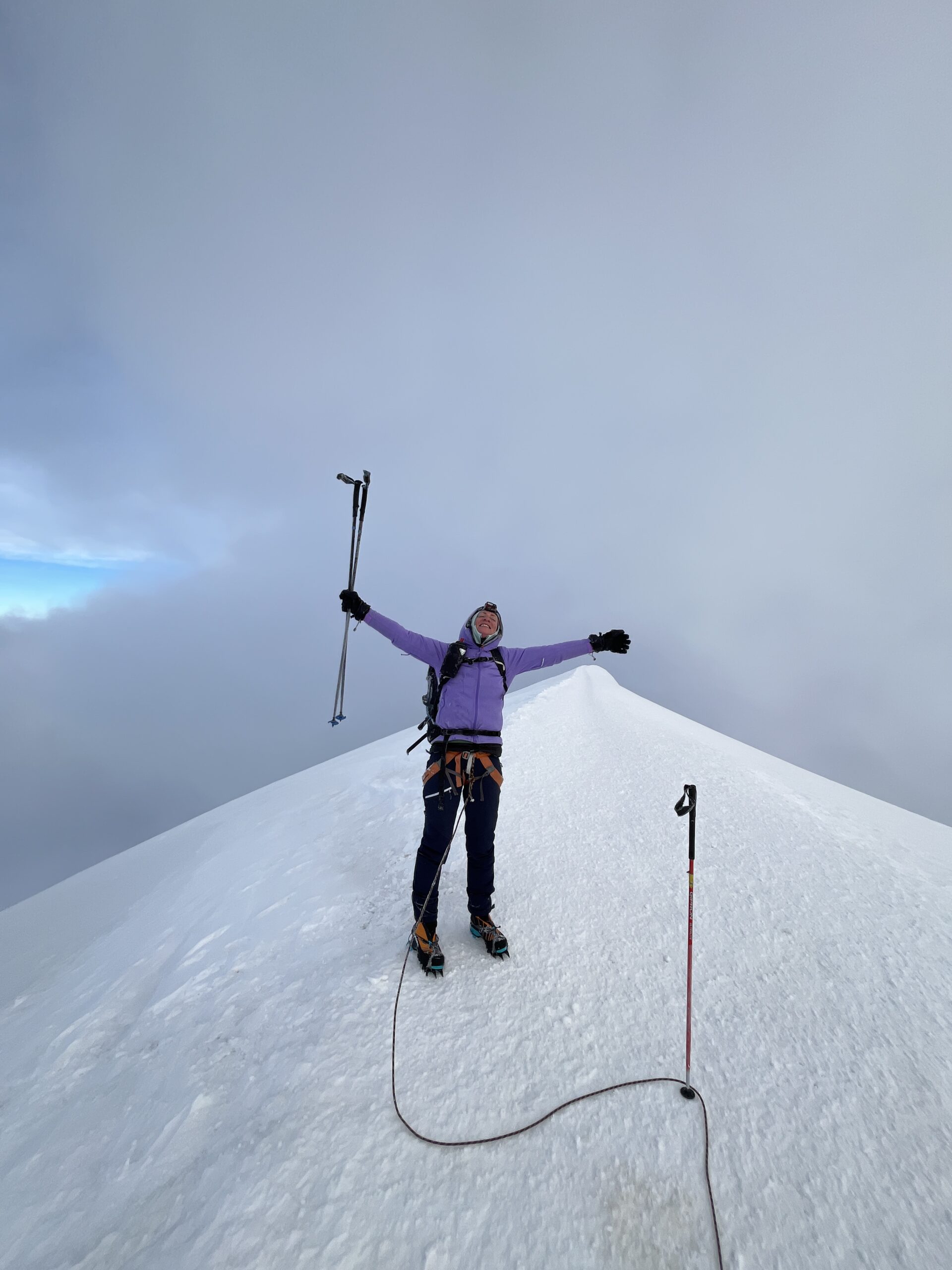
- Sunrise above 4,000 m. First light finds you between the Dôme du Goûter and the Bosses ridge, with France, Italy and Switzerland below.
- Effort managed closely. With no more than two people on the rope, your guide adjusts pace, breaks and food to each climber.
Mont Blanc single push
Searching Availability...
Itinerary – Mont Blanc single push
In the late afternoon, you meet your guide for a gear check and a detailed weather briefing.
The ascent usually starts in the evening (between 8 pm and midnight), allowing you to climb during the night when conditions are more stable.
Night ascent to the Nid d’Aigle, then up to the Tête Rousse hut. Here you switch to full mountaineering mode: crampons, harness, helmet, rope.
The Grand Couloir is the most exposed section of the route because of rockfall: you cross it quickly, under your guide’s direction. The climb continues up the rocky ridge to the Goûter hut, for a short break.
Glacier travel up to the Dôme du Goûter, past the Vallot shelter, then along the narrow, airy Bosses ridge to the summit.
At sunrise or mid-morning. Views across France, Italy, Switzerland and the great faces of the Alps. Your guide decides how long you stay, depending on time, weather and how you feel.
Full descent by the same route. It still takes several hours and constant focus, especially in the Grand Couloir. Back in the valley by late afternoon.
After the climb: plan a night in Chamonix. Do not drive after 20 hours of effort without sleep.
Provided by Nuyama:
- An IFMGA mountain guide throughout the ascent
- Rope, harness, crampons and ice axe
- Shared safety equipment
What to bring:
- Stiff mountaineering boots (double boots recommended)
- Helmet
- Thermal layers, waterproof jacket and trousers, down jacket
- Warm gloves, overmitts and hat
- Head torch and spare batteries
- High-energy food and drinks for 20 hours of exertion
- Glacier sunglasses (category 4) and SPF 50+ sunscreen
- Mountain rescue insurance (compulsory)
All personal equipment can be hired in Chamonix. We’ll be happy to recommend trusted local rental providers.
The itinerary is indicative. Your guide may change, adapt or stop the ascent depending on the weather, mountain conditions and your physical condition. Departure is confirmed five days in advance, based on weather and snow forecasts.
We do not put together groups for this ascent. Success depends heavily on each climber’s fitness, and bringing together people who do not know each other almost always leads to frustration.
A guide takes a maximum of two climbers on the same rope, and the rope team never splits up. If one climber needs to turn back, the entire team descends together. Choose a climbing partner you know well, with a similar level of fitness.
Even with excellent physical fitness, acclimatisation is essential for a successful ascent. Above 4,000 m, everyone reacts differently to altitude, and insufficient acclimatisation is one of the main reasons for turning back during a One Push ascent.
We recommend:
- Spending several days at altitude and, ideally, one or two nights between 2,500 and 3,500 m during the preceding week.
- A preparation day with your guide to assess your level, check your equipment and plan the ascent.
- Building up your endurance over several months through mountain running, ski touring and mountaineering.
For acclimatisation that also serves as training, climbing Gran Paradiso (4,061 m) in a day is a logical step a few days beforehand.
Climbing Mont Blanc in a day is the most physically demanding ascent in our One Push range. The technical difficulty is moderate; what makes the difference is the duration of the effort, the altitude and a night without sleep.
Nuyama scale | This climb |
Physical level | 5/5 — Elite: extreme continuous effort, more than 3,500 m of ascent, exceptional fitness. |
Technical level | 3/5 — Practised: glacier, snow and ice slopes up to 45°, grade II rock ridge, graded PD. |
Before booking, you should be able to tick all these boxes:
- You are an experienced mountaineer who has already climbed above 4,000 m.
- You have the endurance to tackle 3,800 m of continuous ascent.
- You are confident travelling on glaciers, using crampons and moving roped together.
- You are acclimatised: prior acclimatisation is compulsory.
- You can cope with a sleepless night and prolonged physical effort in the cold.
This is not trail running: it is a roped mountaineering ascent on glaciated terrain, where the pace is dictated by safety and altitude.
Mont Blanc single push – Book your ascent
Included
- Guiding by an IFMGA mountain guide throughout the ascent (approximately 20 hours)
- Safety equipment: rope, carabiners, ice screws, etc.
- Breakfast for you and your guide at one of the two Mont Blanc mountain huts.
Not included
- Rescue insurance (compulsory) and cancellation insurance (strongly recommended)
- Your personal equipment
- Transfers to/from Chamonix
- Transport to Les Houches
- Accommodation
- Meals, snacks and personal expenses
- Anything not listed in the “Included” section.
Available extras (on request)
- Transfers to and from Chamonix
- Accommodation in the Chamonix Valley
- A preparation or acclimatisation day with your guide
🏔️ Can you really climb Mont Blanc in a day?
Yes, if you are a very fit, acclimatised mountaineer. The Goûter route single push means 3,800 m of ascent and 18 to 24 hours of continuous effort, starting and finishing in Les Houches.
⌚️ How long does the single push take?
Between 18 and 24 hours: departure between 8 pm and midnight, summit at sunrise or mid-morning, back in the valley by late afternoon.
🏃🏻 How fit do I need to be to climb Mont Blanc in a day?
You need exceptional endurance, previous experience above 4,000 m, and confidence on glaciers, in crampons and moving roped together. Technically, the route is graded PD.
❄️ Do I need to be acclimatised?
Yes, it is compulsory. Several days — ideally one or two nights — between 2,500 and 3,500 m in the week before greatly improve your chances.
🏠 What is the difference with the standard two-day climb?
The standard climb includes a night at the Goûter or Tête Rousse hut and splits the effort over two days. The single push does it all in one go, with no hut booking needed.
⚠️ What is the most dangerous section?
The Grand Couloir, which is exposed to rockfall. We cross it quickly, under the guide’s direction, at the time of day when the risk is lowest.
💰 How much does a guided Mont Blanc single push cost?
From €1,120 per person, including an IFMGA guide, shared equipment and breakfast at the hut.
👥 How many people per guide?
Two at most. Both climbers should know each other well and have a similar fitness level, as the rope team never splits.
🗓️ When can you climb Mont Blanc in a day?
From mid-May to mid-September, depending on weather and snow. Departure is confirmed five days ahead.
🏃🏻 How should I prepare?
Build an endurance base over several months, spend time at altitude, and book a preparation day with your guide. An easier 4,000 m peak such as Gran Paradiso is a good acclimatisation step.
Also discover…
Ready to climb Mont Blanc in one day?
Tell us about your mountain experience, your recent high-altitude ascents and your availability. We’ll discuss your plans with you and organise the ascent together.